

Cables Blog
Shop Cables for Sale:
Fiber Optic Cables •
Network Cables •
Outdoor Cables •
Bulk Ethernet Cables •
Cat6 Cables •
Cat5 Cables •
Cat5e Cables •
Crypto Cables •
Data Center Cables
What Are Fiber Optic Cables? A Complete Technical Guide
Looking to understand fiber optic cables?
by Vikas Dayal • March 31, 2026
In the world of high-performance networking, reliable data transmission is the foundation of modern infrastructure. Whether you are managing a sprawling enterprise data center, wiring a high-end commercial audio-visual system, or optimizing a mission-critical cryptocurrency mining operation, standard copper cabling eventually hits a hard limit. When bandwidth demands skyrocket, distances stretch beyond a few hundred feet, and electromagnetic interference threatens signal integrity, professionals turn to optical fiber.
So, what are fiber optic cables, and why have they become the undeniable backbone of the global telecommunications network?
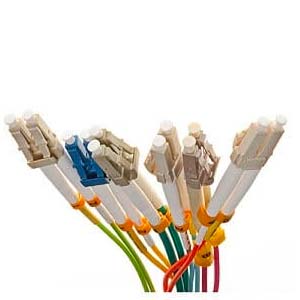
Simply put, a fiber optic cable is an advanced network cable that contains strands of glass fibers inside an insulated casing. Instead of transmitting electrical pulses over copper wire, these cables use pulses of light to transmit data across long distances at unprecedented speeds.
This guide breaks down exactly what fiber optic cable is, how the technology works, the critical differences between single-mode and multimode fiber, and how to select the right optical networking solutions for your specific operational requirements.
The Anatomy of a Fiber Optic Cable
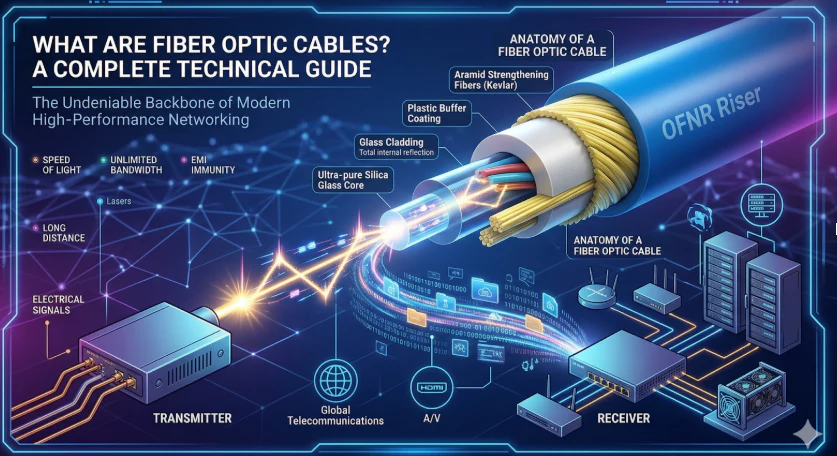
To understand what a fiber optic cable does, you must first look at how it is constructed. While they may look similar to standard electrical cables on the outside, the internal architecture of an optical fiber cable is highly specialized. A standard fiber optic cable consists of several distinct layers, each engineered to protect the fragile optical signal and the glass strand itself.
- The Core: This is the physical center of the cable and the pathway for the light signals. Made of ultra-pure, continuously extruded silica glass (or sometimes specialized plastic), the core is incredibly thin—often the diameter of a human hair.
- The Cladding: Surrounding the core is another layer of glass or plastic called the cladding. The cladding has a slightly lower refractive index than the core. This precise difference in optical density is what keeps the light confined to the core through a principle called total internal reflection.
- The Buffer Coating: Glass fibers are inherently fragile. To protect them from physical damage, moisture, and environmental stress, a plastic coating is applied directly over the cladding.
- Strengthening Fibers (Aramid Yarn): To protect the cable from pulling tension during installation—a critical concern for trade specialists running cable through tight conduits—manufacturers wrap the buffer in strengthening fibers, commonly made of Kevlar or similar aramid yarns.
- The Outer Jacket: The final exterior layer protects the entire assembly. For IT professionals and electrical contractors, the jacket material is heavily regulated by fire codes. Jackets are typically categorized by their UL listing and fire rating, such as Plenum (OFNP) for air-handling spaces, Riser (OFNR) for vertical shafts, or Low Smoke Zero Halogen (LSZH) for high-occupancy environments.
How Fiber Optic Technology Works
When asking "what is a fiber optic cable used for," the answer lies in its ability to move massive amounts of data as light. But how does light travel through a flexible, bending cable without escaping?
The magic of fiber optics relies on a physics principle known as total internal reflection. When a laser or Light Emitting Diode (LED) injects light pulses into one end of the core, those light waves travel down the cable. Because the cladding has a different refractive index than the core, it acts like a continuous mirror. When the light hits the boundary between the core and the cladding, it does not pass through; instead, it bounces back into the core, allowing the light signals to zigzag their way down the length of the cable.
This light-based data transmission system requires three primary components to function:
- The Transmitter: A device that converts standard electronic data signals into light pulses.
- The Optical Fiber: The physical cable medium that carries the light pulses.
- The Receiver: A device at the destination that captures the light pulses and converts them back into usable electrical data for servers, routers, or A/V equipment.
Single-Mode vs. Multi-Mode Fiber: Choosing the Right Cable
For network administrators and data center managers, one of the most critical infrastructure decisions is choosing between the two primary types of optical fiber: single-mode and multimode. Using the wrong type of cable will result in severe signal loss, incompatible network topologies, and costly system downtime.
Single-Mode Fiber Optic Cable (SMF)
Single-mode fiber is designed to transmit a single light path (or mode) directly down the center of the core.
- Core Size: Extremely narrow, typically 9 micrometers (µm) in diameter.
- Light Source: Uses expensive, highly focused laser diodes.
- Distance and Speed: Because there is only one path for the light to take, signal dispersion is practically eliminated. This allows single-mode fiber to transmit high-speed data over vast distances—often tens or even hundreds of kilometers—without the need for signal repeaters.
- Common Use Cases: Telecommunication networks, long-haul data center interconnects, campus-wide network backbones, and Fiber-To-The-Premises (FTTP) broadband rollouts.
Multi-Mode Fiber Optic Cable (MMF)
Multimode fiber allows multiple light paths (modes) to travel through the cable simultaneously, bouncing off the cladding at different angles.
- Core Size: Much wider than single-mode, typically 50 µm or 62.5 µm in diameter.
- Light Source: Utilizes LEDs or Vertical-Cavity Surface-Emitting Lasers (VCSELs), which are more cost-effective than the heavy-duty lasers used in single-mode systems.
- Distance and Speed: Because multiple light paths travel at slightly different speeds (modal dispersion), multimode fiber is limited by distance. It is generally restricted to ranges of 300 to 500 meters at 10 Gbps speeds, though newer iterations (OM4 and OM5) support 40Gbps and 100Gbps over shorter distances.
- Common Use Cases: Server-to-server connections within a data center, local area networks (LANs), audio-visual racks, and internal building distribution.
Key Takeaways for IT Professionals:
- Use Single-Mode for long distances and massive bandwidth expansion.
- Use Multi-Mode for short-reach, high-density environments where transceiver costs need to be optimized.
- Never mix single-mode and multimode cables in the same link; the differing core sizes will cause catastrophic signal loss.
Fiber Optic Cable vs. Copper Cable: What is the Difference?
A common question among those looking to upgrade their infrastructure is: What is the difference between fiber optic cable and normal cable? And furthermore, Is fiber optic cable the same as Ethernet cable?
While standard copper Ethernet cables (like Cat6 or Cat6a) are excellent for short-run desktop connections, Power over Ethernet (PoE) applications, and standard home networking, they operate by sending electrical pulses over twisted pairs of copper wire. Fiber optics use photons (light). This fundamental difference gives fiber several major advantages:
1. Immunity to Electromagnetic Interference (EMI)
Copper wires act like antennas; they can absorb electromagnetic interference from heavy machinery, high-voltage electrical cables, and fluorescent lighting. This interference corrupts data packets. Because fiber optic cables use light and contain no metallic components, they are 100% immune to EMI and Radio Frequency Interference (RFI). This makes them the only reliable choice for industrial environments, elevator shafts, and heavy-duty A/V trade installations.
2. Drastically Reduced Signal Loss (Attenuation)
Over long distances, electrical signals degrade. Standard copper Ethernet is strictly limited to 100 meters (328 feet) before the signal drops off significantly. Optical fiber, particularly single-mode, experiences microscopic levels of attenuation, allowing a clean, uncompressed signal to travel miles without a booster.
3. Unlimited Bandwidth Potential
While top-tier copper cables max out at 10 Gbps (Gigabits per second) over very short distances, optical fiber can theoretically support virtually unlimited bandwidth. Upgrading a fiber network often just requires upgrading the transceivers on either end, rather than ripping and replacing the physical cabling inside the walls.
4. Enhanced Network Security
It is relatively easy for malicious actors to tap into a copper line and read the electromagnetic signals leaking from it. Tapping a fiber optic cable is incredibly difficult; doing so requires physically cutting the glass and splicing in a tap, which immediately causes a noticeable drop in light levels that sets off network alarms.
Key Benefits and Limitations of Fiber Optic Technology
Understanding what fiber optic cables are also requires acknowledging both their strengths and their inherent challenges. While they represent the gold standard in cabling, they are not a universal replacement for every copper wire.
The Major Advantages of Fiber Optics:
- Future-Proof Infrastructure: Fiber installed today will easily support the 100G, 400G, and 800G network speeds of tomorrow.
- Space and Clutter Reduction: A single, thin fiber optic cable can carry more data than massive bundles of thick copper cables, freeing up vital space in data center cable trays and A/V racks.
- Zero Spark Hazard: Because they carry light instead of electricity, optical fibers present no fire hazard in highly explosive or chemical-rich environments.
What is the Biggest Downside to Fiber Optic Cabling?
- Fragility and Bend Radius Constraints: Glass fibers can break if bent too sharply. Installers must carefully adhere to strict "bend radius" guidelines to prevent micro-fractures in the core, which cause signal loss.
- Installation Complexity: Terminating copper cables is quick and requires simple crimping tools. Terminating fiber optics requires precise cleaving, polishing, and highly specialized fusion splicing equipment.
- Initial Cost: While the cost of the raw fiber cable itself has dropped to be comparable with high-end copper, the optical transceivers, switches, and specialized network cards required to run a fiber network are significantly more expensive.
Common Use Cases for Fiber Optic Cables
Because of its versatility, high-stakes professionals across multiple industries rely on custom-manufactured and bulk fiber optics.
IT and Data Center Infrastructure
Network administrators utilize fiber optics to create high-speed backbones linking storage area networks (SANs), core routers, and blade servers. In high-density environments, IT pros utilize multi-fiber MTP/MPO connectors, which bundle 12 to 24 fibers into a single compact connection, drastically reducing cable clutter and improving airflow around server racks.
Trade Specialists: Audio/Visual and Electrical
For high-end home theaters, stadium displays, and broadcast studios, uncompressed 4K and 8K video requires massive bandwidth. A/V installers frequently use Active Optical Cables (AOC)—which feature built-in optoelectronic converters—to run HDMI or DisplayPort signals across large venues without the signal degradation inherent to long copper runs. Additionally, electrical contractors rely on armored fiber cables when running lines through harsh construction environments or direct-burial applications.
Niche Tech Communities and Prosumers
Cryptocurrency mining operations, which require absolute maximum uptime and immediate data transmission to mining pools to secure blocks, frequently run fiber to their localized switches. Similarly, high-end "prosumers" building sophisticated home offices or gaming setups are increasingly adopting Fiber to the Home (FTTH) connections for zero-latency, gigabit-speed internet that remains completely unaffected by neighborhood network congestion.
Frequently Asked Questions About Fiber Optic Cabling
To further clarify what fiber optic cable is, here are answers to the most common questions from networking consumers and IT initiates.
Is fiber optic different than Wi-Fi? Yes. Wi-Fi is a wireless networking technology that uses radio waves to transmit data through the air over short distances. Fiber optic is a physical, wired infrastructure. However, they work together: the Wi-Fi router in your home or office is almost certainly connected to a broader internet service provider network that relies entirely on fiber optic cables to deliver data to your local neighborhood.
Is fiber optic better than Wi-Fi? For sheer performance, reliability, and security, a hardwired fiber optic connection is vastly superior to Wi-Fi. It offers symmetrical upload and download speeds, zero wireless interference, and lower latency. However, Wi-Fi provides mobility and convenience for endpoint devices like smartphones and laptops that cannot be physically tethered to a wall.
What does fiber optic cable do in an audio setup? In consumer and professional audio, you may encounter a specific type of fiber cable known as a TOSLINK (Toshiba Link) optical audio cable. It uses an LED to transmit digital audio streams (like Dolby Digital or DTS) from a source component to a receiver. Because it is an optical signal, it is completely immune to ground loops and the electrical hum that can plague traditional analog RCA copper connections.
Are fiber optic cables everywhere? Increasingly, yes. While the final few feet into an older home or office might still be standard copper wiring, almost the entirety of the global internet, oceanic communication lines, cellular tower backhauls, and corporate enterprise networks run exclusively on fiber optic cables.
Investing in Optical Reliability
When system downtime translates directly to lost revenue, and network bottlenecks stifle productivity, choosing the right cabling infrastructure is not an area for compromise. Understanding what fiber optic cables are, how they safely channel light across vast distances, and when to deploy single-mode versus multimode allows IT professionals and trade specialists to build networks that perform under pressure.
Whether you require bulk spools of plenum-rated fiber for a new building rollout, precision-tested patch cords for a data center upgrade, or rugged armored fiber for an industrial facility, prioritizing high-quality manufacturing, exact specifications, and proven reliability will ensure your data reaches its destination—at the speed of light.