Fiber Optic Connectors and Kits - Quick, Precise Connectivity for Optical Networks
Fiber optic connectors provide a fast and reliable method of joining two optical fibers without the need for splicing. They align fiber cores with high precision, allowing light signals to pass through with minimal reflection or loss. These connectors are critical for simplifying installation and maintenance across data centers, telecom systems, and enterprise networks.
With over 100 types of fiber optic connectors on the market, selecting the right one depends on the requirements of your specific project-such as performance, form factor, and environment.
-
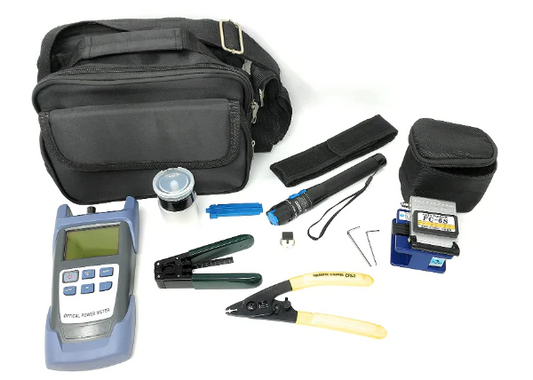
Fiber Optic Field Installable Connector Prep and Test Kit
Fiber-Connector-KitFiber Optic Field Installable Connector Prep and Test Kit
Fiber-Connector-KitRegular price $300.00 USDRegular priceSale price $300.00 USD -
LC UPC Field Installable Singlemode 9 micron Connector- 10 Pack
LC-U-CONN-SMRegular price $100.00 USDRegular priceSale price $100.00 USD -
LC APC Field Installable Singlemode 9 micron Connector- 10 Pack
LC-A-CONN-SMRegular price $100.00 USDRegular priceSale price $100.00 USD -
LC UPC Field Installable Multimode OM3 50 micron Connector 10 Pack
LC-U-OM3-CONNRegular price $120.00 USDRegular priceSale price $120.00 USD
Common Types of Fiber Optic Connectors:
- LC (Lucent Connector): Small form factor, ideal for high-density applications
- SC (Subscriber Connector): Square design, commonly used in duplex configurations
- ST (Straight Tip): 2.5mm ferrule, bayonet-style mount, widely used in legacy networks
- FC (Ferrule Connector): Ceramic ferrule with a metal body, great for harsh environments
- MPO (Multi-Fiber Push-On): MPO (Multi-Fiber Push-On): High-density connector used in backbone and data center applications
Frequently Asked Questions
What is a fiber optic connector?
It's a device used to align and join two fiber optic cables, allowing for quick connection and disconnection without the need for splicing.
Which fiber connector supports dual strands?
MTRJ connectors hold two fibers in a single ferrule, allowing for compact duplex connections.
How do I choose the right connector?
The choice depends on your network design, equipment compatibility, density requirements, and environment. If you're unsure, our team at Cables.com can help guide your selection.
When to Use Fiber Connectors
- Building or upgrading telecom and data center infrastructure
- Simplifying fiber connections in patch panels and network cabinets
- Minimizing installation time on large-scale fiber deployments
- Reducing risk of signal loss from poor splicing or alignment

